Eldritch-Trace DSL
Eldritch-Trace is a Domain Specific Language (DSL) and semantic model, which is
used to filter sequences of events whose tag contains a u32 encoded type
(primarily used with aetherus-events)
Eldritch-Trace DSL defines the clearly what the patterns and sequences of interest should be matched to, then the semantic model runs something akin to a parses combinator in order to find all sequences of events that satisfy the conditions.
API Docs
In addition to this book, you may also wish to read [the API documentation](TOOD: Add link to docs generated in github pages or crates.io)
License
Eldritch-Trace DSL is pre-emptively licensed as MIT, but might decide to change that.
Sample
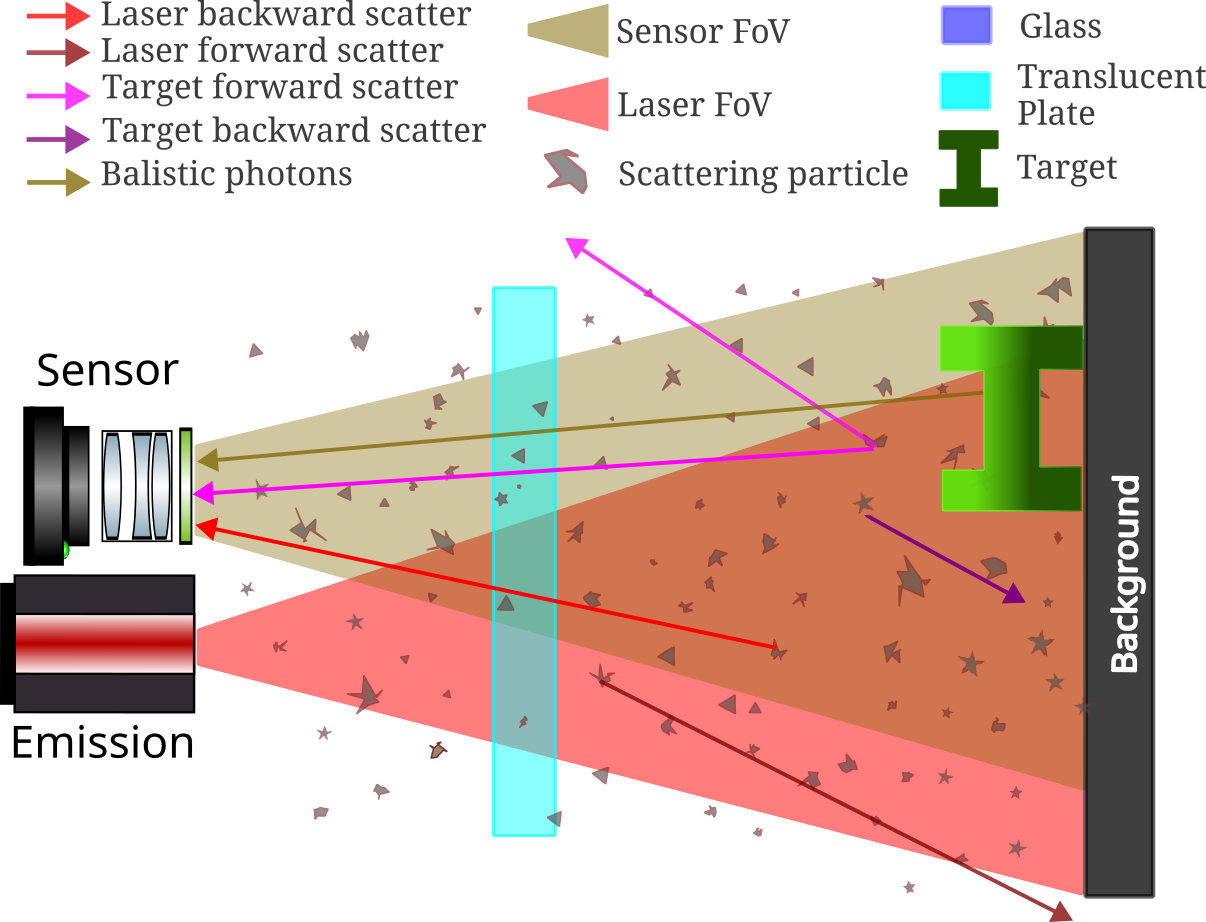
Here is an example script used to filter the events for the scene described in the diagram below.
Getting Started
CLI
Prebuilt
TODO:
- Build release in CI/CD for Linux/Mac/Windows and make it available to download for users to make use of right away
Build from source
- Clone the repository
- Build with
cargo build --release
Usage
Run with ./target/release/eldritch --spec spec/encoding_spec.md <my_script>.et
This will generate for each rule:
- graphviz
.dotdiagram of each one of the rules described, showing all possible histories. The files can be found in the same directory as the ledger path or in the explicit output directory. - serialised filtered signals in the same directory as the input signals stream
Library
This can also be used as a library, which exposes a FFI compatible with C-ABI, such that it can be called from most languages. The input will still be a path to the script or a string input with the script content.
TODO:
- Expose the bindgen version and use it with Python/Julia
User Guide
Here is an example script used to filter the events for the scene described in the diagram below.
# Define the serialised Ledger and Signals collected
# ============================================================
ledger  = "../../aetherus-scene/underwater-paper/out/simulation_ledger.json"
signals = "../../aetherus-scene/underwater-paper/out/multispectral/photon_collector_spad_sensor.csv"

# Define material and surface identifiers we want to match for
# ============================================================

src water_id = any[Mat("seawater"), MatSurf("Water:Water_material")]
src glass_id = any[Mat("glass"), any[MatSurf("Tank:Tank_material"), MatSurf("Tank-Water:Tank_material")]]
src toy_id   = Surf("TargetToy")
src tube_id  = Surf("TargetTube")
src air_id   = Mat(0)

# Define encoding patterns to match for
# =====================================

pattern water_scatter     = MCRT | Material  | Elastic | X            | water_id
pattern water_backscatter = MCRT | Material  | Elastic | X | Backward | water_id
pattern glass_interf      = MCRT | Interface | X                      | glass_id

pattern toy_surf          = MCRT | Reflector | X                      | toy_id
pattern tube_surf         = MCRT | Reflector | X                      | tube_id


# Define sequences of events in the photon history to search for
# ==============================================================

sequence toy_detect = seq[
    Emission | X | Light(0),
    * X,
    toy_surf,
    * X,
    Detection | X | Detector(0),
]

sequence tube_detect = seq[
    Emission | X | Light(0),
    * X,
    tube_surf,
    * X,
    Detection | X | Detector(0),
]

sequence seq_water_backscatter = seq[
    Emission | X | Light(0),
    * X,
    water_scatter,
    * X,
    Detection | X | Detector(0),
]

# Note how rule tries to validate all conditions enumerated
rule backscatter = {
    ! any[tube_surf, toy_surf],
    seq[
        Emission | X | Light(0),
        * X,
        + water_scatter,
        * X,
        Detection | X | Detector(0),
    ],
}

rule toy_or_tube_detect = {
    any[toy_surf, tube_surf],
    seq[
        Emission | X | Light(0),
        * X,
        + water_scatter,
        * X,
        Detection | X | Detector(0),
    ],
}
The ledger serialised to a JSON file is as follows:
{
  "grps": {},
  "src_map": {
    "Mat(0)": [ { "Mat": "air" } ],
    "Mat(2)": [ { "Mat": "translucent_pla" } ],
    "Mat(1)": [ { "Mat": "mist" } ],
    "Surf(0)": [ { "Surf": "Background" } ],
    "Surf(1)": [ { "Surf": "Target" } ],
    "MatSurf(65535)": [ { "MatSurf": "TranslucentPlate:TranslucentPLA" } ]
  },
  "start_events": [ { "seq_id": 0, "event": "0x1010000" } ],
  "next_mat_id": 3,
  "next_surf_id": 2,
  "next_matsurf_id": 65534,
  "next_light_id": 0,
  "next": {
    "0": { "0x01010000": 1 },
    "1": { "0x0300FFFF": 9, "0x0301FFFF": 2, "0x03A00001": 70268 },
    "2": { "0x03A0FFFF": 3 },
    "3": { "0x0300FFFF": 391, "0x03010001": 4, "0x03A0FFFF": 5 },
    "4": { "0x05000000": 50 },
    // ...more entries...
  },
  "prev": {
    "1": "0, 0x01010000",
    "2": "1, 0x0301FFFF",
    "3": "2, 0x03A0FFFF",
    "4": "3, 0x03010001",
    "5": "3, 0x03A0FFFF",
    // ...more entries...
  },
  "next_seq_id": 3747279,
}
Language Reference Manual
Bachus-Naur Form compatible with ANTLR parser generator:
Declarations = { Declaration };

Declaration = SrcDecl
            | SeqDecl
            | PatternDecl
            | RuleDecl
            ;
Comment     = "#" { !"#" anycharacter } ;

SrcDecl     = "src" Ident "=" SrcIdValue ;
PatternDecl = "pattern" Ident "=" Pattern ;
SeqDecl     = "sequence" Ident "=" Seq ;
RuleDecl    = "rule" Ident "=" "{" ConditionItems "}" ;

SrcIdValue = SrcId | SrcIdAny | Ident | "X" ;

SrcId      = SrcIdName | SrcIdVal ;
SrcIdName  = SrcIdType "(" String ")" ;
SrcIdVal   = SrcIdType "(" Number ")" ;
SrcIdType  = "Mat" | "Surf" | "MatSurf" | "Light" | "Detector" ;

SrcIdAny   = "any" "[" SrcIdItems "]" ;
SrcIdItems = SrcIdItem { "," SrcIdItem } ;
SrcIdItem  = SrcId | Ident ;

Pattern    = Fields "|" SrcIdValue ;
Fields     = FieldExpr { "|" FieldExpr } ;
FieldExpr  = FieldId | "X" ;

InlinePattern       = Pattern | Ident ;
InlinePatternItems  = InlinePattern { "," InlinePattern } ;
PatternAny          = "any" "[" InlinePatternItems "]" ;
PatternSet          = InlinePattern | PatternAny | "X" ;
PredicatedPattern   = "!" PatternSet | PatternSet ;

Repetition = "*"
           | "+"
           | "?"
           | "{" [ Number ] [ "," [ Number ] ] "}"
           ;

RepetitionPattern = Repetition PredicatedPattern
                   | PredicatedPattern ;

PatternItems = RepetitionPattern { "," RepetitionPattern } ;

Seq = "seq" "[" PatternItems "]" ;

Condition      = RepetitionPattern | Seq ;
ConditionItems = Condition { "," Condition } ;

FieldId   = Ident ;
Ident     = letter { letter | digit | "_" | "." } ;
Decimal   = digit { digit } ;
Hex       = "0x" hex_digit { hex_digit } ;
Number    = Decimal | Hex ;
String    = "\"" { Character } "\"" ;
Character = character
            | ["\\"] anycharacter ;
Example:
# Define the serialised Ledger and Signals collected
# ============================================================
ledger  = "../../aetherus-scene/underwater-paper/out/simulation_ledger.json"
signals = "../../aetherus-scene/underwater-paper/out/multispectral/photon_collector_spad_sensor.csv"

# Define material and surface identifiers we want to match for
# ============================================================

src water_id = any[Mat("seawater"), MatSurf("Water:Water_material")]
src glass_id = any[Mat("glass"), any[MatSurf("Tank:Tank_material"), MatSurf("Tank-Water:Tank_material")]]
src toy_id   = Surf("TargetToy")
src tube_id  = Surf("TargetTube")
src air_id   = Mat(0)

# Define encoding patterns to match for
# =====================================

pattern water_scatter     = MCRT | Material  | Elastic | X            | water_id
pattern water_backscatter = MCRT | Material  | Elastic | X | Backward | water_id
pattern glass_interf      = MCRT | Interface | X                      | glass_id

pattern toy_surf          = MCRT | Reflector | X                      | toy_id
pattern tube_surf         = MCRT | Reflector | X                      | tube_id


# Define sequences of events in the photon history to search for
# ==============================================================
sequence seq_water_backscatter = seq[
    Emission | X | Light(0),
    * X,
    water_scatter,
    * X,
    Detection | X | Detector(0),
]

# Note how rule tries to validate all conditions enumerated
rule backscatter = {
    ! any[tube_surf, toy_surf],
    seq[
        Emission | X | Light(0),
        * X,
        + water_scatter,
        * X,
        Detection | X | Detector(0),
    ],
}

rule toy_or_tube_detect = {
    any[toy_surf, tube_surf],
    seq[
        Emission | X | Light(0),
        * X,
        + water_scatter,
        * X,
        Detection | X | Detector(0),
    ],
}
Predicates
The predicates are identical to a parser generator or BNF description, since our sequence matching has very much in common to the logic behind a parser combinator. The predicates are inspired from pest.rs with the change that the operator shows as a prefix in our grammar.
Negation: !
The ! unnary/monadic operator signifies that the pattern described should not
be matched, not progress the event chains and move on to check next pattern.
Repetition
| Repetition syntax | Meaning |
|---|---|
? <pattern> | Optionally match pattern |
\* <pattern> | Match pattern zero or more times |
+ <pattern> | Match pattern one or more times |
{n} <pattern> | Match pattern exactly n times |
{m,n} <pattern> | Match pattern between m and n times |
{,n} <pattern> | Match pattern at most n times |
{n,} <pattern> | Match pattern at least n times |
Sets
anyseqperm
Any: any
any is effectively an OR of a list of src fields or patterns listed:
any[Mat(0), Mat("water"), MatSurf("water_interface")]any[pattern_id_0, MCRT | Material | X | SrcId(0)]
Sequence: seq
seq is the set constructor of a sequence, describing a series of pattern that
must match in order. Each of the patterns might be predicated by a negative or
repetition operator.
Example:
seq[
    Emission | X | Light(0),
    * X,
    target_pattern,
    * X,
    Detection | X | Detector(0),
]
Permutation: perm
![WARN] This functionality is not covered yet, but it should provide the possibility to be consumed only within a sequence, such that some events can be described out-of-order.
Source Declaration: src
src water_src = any[Mat(0), Mat("water"), MatSurf("water_interf")]
Pattern Declaration
Patterns are described as concatenation of field specifiers, that are described
in the encoding specification used, don’t care (X) fields when they are required
to be masked out and a source field that can be explicitly constructed, or used
from a previous src declaration.
pattern water_scatter = MCRT | Material | Elastic | X | Mat("water")
pattern water_scatter = MCRT | Material | Elastic | X | any[Mat(0), Mat("water")]
pattern water_scatter = MCRT | Material | Elastic | X | water_src
Sequence
A sequence describes the order of event patterns to be matched.
sequence seq_water_backscatter = seq[
    Emission | X | Light(0),
    * X,
    water_scatter,
    * X,
    Detection | X | Detector(0),
]
Rule: rule
A rule describes the set of conditions to be met by a terminal UID in the
chain of events.
Conditions can be:
- Patterns, predicated or not
- Set of patterns i.e.
any[pattern_1, pattern_2, ...] - Sequence to be matched
Bot patterns and sequences can be written inline the rule declarations or used as identifier of previously declared values.
rule toy_or_tube_detect = {
    any[toy_surf, tube_surf], # Set match
    ! boundary_surf,          # Predicated indentifier pattern
    seq[
        Emission | X | Light(0),
        * X,
        + water_scatter,      # Repetition of identifier inside sequence
        * X,
        Detection | X | Detector(0),
    ],
    my_other_sequence,
}
Analysis Process
TODO:
- Here shown an example of how the output can be used.
FAQ
Placeholder for future questions, used to aid other users and provide a track of what’s unclear inside the docs/book.